<?xml version="1.0" encoding="utf-8"?><feed xmlns="http://www.w3.org/2005/Atom" ><generator uri="https://jekyllrb.com/" version="3.10.0">Jekyll</generator><link href="https://stuff.parkermoore.de/atom.xml" rel="self" type="application/atom+xml" /><link href="https://stuff.parkermoore.de/" rel="alternate" type="text/html" /><updated>2026-05-08T10:36:39-07:00</updated><id>https://stuff.parkermoore.de/atom.xml</id><title type="html">parker’s stuff</title><author><name>Parker Moore</name></author><entry><title type="html">Derek Sivers on friendships that serve you &amp;amp; leaning into things you hate</title><link href="https://stuff.parkermoore.de/2024/11/17/derek-sivers-on-friendships-that-serve-you-and-leaning-into-things-you-hate.html" rel="alternate" type="text/html" title="Derek Sivers on friendships that serve you &amp;amp; leaning into things you hate" /><published>2024-11-17T20:59:01-08:00</published><updated>2024-11-17T20:59:01-08:00</updated><id>https://stuff.parkermoore.de/2024/11/17/derek-sivers-on-friendships-that-serve-you-and-leaning-into-things-you-hate</id><content type="html" xml:base="https://stuff.parkermoore.de/2024/11/17/derek-sivers-on-friendships-that-serve-you-and-leaning-into-things-you-hate.html"><![CDATA[<p><a href="https://sive.rs">Derek Sivers</a> has been a favorite thinker of mine for
several years now, and this latest interview on The Tim Ferriss Show is no
exception. <a href="https://tim.blog/2024/11/14/derek-sivers-2-transcript/">Full transcript
here</a>. Two ideas I
wanted to highlight:</p>

<h4 id="1-lean-into-things-you-hate-or-thought-you-hated">1: Lean into things you hate (or thought you hated)</h4>

<blockquote>
  <p>The theme is that if you feel completely averse to something, get to know
it better, that <strong>whatever you feel yourself leaning away from, try
leaning into.</strong> If you hate opera, then go learn more about opera. And if
you hate sports, well, then go learn more about sports. It’s usually just
learning about something gives you an appreciation for this thing that
you used to just dismiss.</p>

  <p>So now, it’s my — at the end of the year, last year, I just thought,
“God, this has been, I think, maybe the greatest year of my life. I think
this is the happiest I have ever been in my whole life.” <strong>And I think
the reason why was because I had five major things in one year that I
used to hate that now I love.</strong> I think, “God, this is the greatest joy.”</p>
</blockquote>

<p>Derek is somewhat unique in the way he leads with curiosity. As he’s gotten
older and wiser, he’s used this tendency to teach himself this lesson: if
at first you dismiss something, use that as a cue to lean in and learn more
about it. Worst case, you learn that it really isn’t for you. Best case,
you found something new to love.</p>

<h4 id="2-find-friends-that-challenge-you">2: Find friends that challenge you</h4>

<blockquote>
  <p>Tim Ferriss: I would actually build on that to say that I look to my
close relationships, and I pause and question how I’m thinking about
friendships if, in every case, there isn’t something substantial I
disagree with each of those friends on.</p>

  <p>…</p>

  <p>Tim Ferriss: I really want friends where the differences of opinion bring
us closer, and make our friendships more valuable. Not the other way
around.</p>

  <p>…</p>

  <p>Derek Sivers: I thought about that in terms of the thought portfolio in
our head. Any given person. So you say it with the friends you have
around. But I assume, aren’t you then, by knowing your friends so well
when you’re in a certain situation, you’re thinking about what to do. You
don’t just have Tim’s thoughts. You also have this friend’s thoughts, and
that friend’s thoughts. And it’s like, “How would this friend of mine
approach this?”</p>

  <p>…</p>

  <p>Tim Ferriss: And I think that in your new book, for instance, does a very
good job of discussing perspectives, and perspective taking, and how you
can read many things differently from different viewpoints. And you want
friends who can help you do that, so that you don’t get trapped in your
own thought loops. And furthermore, just on a very practical sense, you
want to be able to speak truthfully to your friends, and you want them to
be able to do the same. And if you do that, and you talk about a really
wide breadth of things. If you never have conflict, one or both you is
probably being dishonest.</p>

  <p>…</p>

  <p>Tim Ferriss: And if you’re going to have some friction in the system,
which you probably will if you’re really being honest. Then, you’re going
to need to be good at conflict resolution, or repair, or talking about
hard things. So that’s a very long stream of consciousness that I just
let out. But if I look for friends who I can and will disagree with on
things.</p>
</blockquote>

<p>That’s a bit of a long series of quotes there but it’s just so good.
When you disagree with friends and loved ones, you have an opportunity to
learn, an opportunity to see the world from another perspective. To
surround yourself with people who can teach you in this way, through
disagreement, can give you a natural advantage when difficult or
challenging or otherwise interesting things happen in your life: “how would
so-and-so think about this?” That impulse to look at the world from other
perspectives is like a superpower in this world of thought bubbles.</p>

<p>Highly recommend this episode, and every episode of Derek’s on Tim’s show.
Their friendship is endearing &amp; philosophical, and their conversations are
such a joy to listen to.</p>]]></content><author><name>Parker Moore</name></author><category term="podcast" /><category term="tim-ferriss" /><category term="derek-sivers" /></entry><entry><title type="html">How do you sit quietly in the middle of a storm? - Search Engine Podcast</title><link href="https://stuff.parkermoore.de/2024/11/10/how-do-you-sit-quietly-in-the-middle-of-a-storm-search-engine-podcast.html" rel="alternate" type="text/html" title="How do you sit quietly in the middle of a storm? - Search Engine Podcast" /><published>2024-11-10T14:21:12-08:00</published><updated>2024-11-10T14:21:12-08:00</updated><id>https://stuff.parkermoore.de/2024/11/10/how-do-you-sit-quietly-in-the-middle-of-a-storm-search-engine-podcast</id><content type="html" xml:base="https://stuff.parkermoore.de/2024/11/10/how-do-you-sit-quietly-in-the-middle-of-a-storm-search-engine-podcast.html"><![CDATA[<blockquote>
  <p>When Rev first wanted to deepen her meditation practice, she started going to retreats.
A retreat might last five days, a week or longer.
Often these retreats are entirely silent, meaning for the whole time you will not talk.</p>
</blockquote>

<p>Rev:</p>

<blockquote>
  <p>“You realize that in this spaces that are set just so and everything is
right and it’s all prepared, you still manage to drive yourself nuts.
And to hate people and to love people, you do the whole gamut in there in
a little tiny, tiny, tiny, tiny constructed container.  And yet you
manage to play out all of the shenanigans, do all the things.  You hate
people, you love them, you want to have sex with them, you want them to
get as far away as possible.  You know, the smallest things hurt your
feelings, you get upset, you get cold and distant.  You do all the things
and <strong>you realize, well, wait a minute, if all of this is here, even though
I’m in a different space, maybe that I have something to do with creating
all of this and it’s not everybody else’s fault.  I might have to take
responsibility for my life.</strong></p>
</blockquote>

<p>PJ:</p>

<blockquote>
  <p>So it’s like the thing that it offers or one of the things it offers is
that if it’s like you find out that <strong>even if everything were taken away,
like the things we think the world is doing to us, when you take away the
world, you see that we do them to ourselves.</strong></p>
</blockquote>

<p>It reminds me of something <a href="https://tim.blog/2024/10/01/elizabeth-gilbert-2-transcript/#content">Tim Ferriss recently quoted on a podcast
episode with Elizabeth Gilbert</a>:</p>

<blockquote>
  <p><strong>“How are we complicit in creating the conditions we say we don’t
want?”</strong></p>
</blockquote>

<p>He was quoting Jerry Colonna from <a href="https://tim.blog/2019/06/14/the-tim-ferriss-show-transcripts-jerry-colonna-373/">another
episode</a>.
Jerry elaborates:</p>

<blockquote>
  <p>I like to use the word <em>complicit</em> and not <em>responsible</em>. 90% of the time
when I first ask that question, people hear the word “How have I been
responsible for the conditions?” Complicitness is important, because it’s
relieving the person from the burden of feeling responsible for all the
shit in their lives, because that’s not fair to carry that
responsibility. But it’s helpful to think of ourselves as somehow being
served by the challenges that we’re going through.</p>

  <p>The second piece of that is that “I <em>say</em> I don’t want.” And that sort of
unpacks that notion even further, which is there’s something oftentimes
about the way in which we operate and the way we set up the conditions of
our lives to be in unconscious service to us. The psychological term is
<em>secondary gain</em>. But there are ways in which we find ourselves repeating
patterns in our life. We always date the same type of person. We are
always finding ourselves in the same kind of job. We’re always frustrated
by the same sorts of situation. And so it’s really useful to sort of
start to unpack that. So that’s that question.</p>
</blockquote>

<p>Rev’s observation that <em>“when you take away the world, you see that we do
them to ourselves”</em> strikes right at the heart of Jerry’s observation that
we are complicit in creating the conditions. Our internal narrative, our
internal experience becomes externalized in the world around us through our
interactions, relationships, and behaviors. It follows that to improve our
experience in the world, we might start by improving our internal world.</p>]]></content><author><name>Parker Moore</name></author></entry><entry><title type="html">Skrjabin: Le poème de l’extase ∙ hr-Sinfonieorchester</title><link href="https://stuff.parkermoore.de/2024/08/01/skrjabin-le-poeme-de-lextase-hr-sinfonieorchester.html" rel="alternate" type="text/html" title="Skrjabin: Le poème de l’extase ∙ hr-Sinfonieorchester" /><published>2024-08-01T21:31:00-07:00</published><updated>2024-08-01T21:31:00-07:00</updated><id>https://stuff.parkermoore.de/2024/08/01/skrjabin-le-poeme-de-lextase-hr-sinfonieorchester</id><content type="html" xml:base="https://stuff.parkermoore.de/2024/08/01/skrjabin-le-poeme-de-lextase-hr-sinfonieorchester.html"><![CDATA[<p>What a stunning piece by the 19th &amp; 20th century composer <a href="https://en.wikipedia.org/wiki/Alexander_Scriabin">Alexander
Scriabin</a>, performed by
the <a href="https://en.wikipedia.org/wiki/Frankfurt_Radio_Symphony">Frankfurt Radio
Symphony</a>.</p>

<p>It was the first time I have (knowingly) encountered Scriabin and I was
really quite transported by the sweeping musical ideas. Highly recommend!</p>]]></content><author><name>Parker Moore</name></author></entry><entry><title type="html">Astronomy Picture of the Day</title><link href="https://stuff.parkermoore.de/2023/02/09/astronomy-picture-of-the-day.html" rel="alternate" type="text/html" title="Astronomy Picture of the Day" /><published>2023-02-09T21:29:57-08:00</published><updated>2023-02-09T21:29:57-08:00</updated><id>https://stuff.parkermoore.de/2023/02/09/astronomy-picture-of-the-day</id><content type="html" xml:base="https://stuff.parkermoore.de/2023/02/09/astronomy-picture-of-the-day.html"><![CDATA[<p>In 1995, when the Internet was still young, two astronomers began a public
feed of astronomy photos. They called it “Astronomy Picture of the Day.”
These astronomers, Robert Nemiroff and Jerry Bonnell, have posted fantastic
photographs and videos of astronomical phenomena continuously every since.</p>

<p>These days, many entries are
<a href="https://apod.nasa.gov/apod/lib/apsubmit2015.html">submitted</a> from folks
all over the world, enthusiasts and professionals alike. A <a href="https://apod.nasa.gov/apod/ap230209.html">recent post
entitled Nacreous Clouds over
Lapland</a> caught my eye and I had
to share it here:</p>

<p><img src="https://apod.nasa.gov/apod/image/2302/PearlCloudDennis7.jpg" alt="Nacreous clouds, a.k.a. mother of pearl clouds in
Finland" /></p>

<blockquote>
  <p>Explanation: Vivid and lustrous, wafting iridescent waves of color wash
across this skyscape from Kilpisjärvi, Finland. <a href="https://www.atoptics.co.uk/highsky/nacr1.htm">Known as nacreous
clouds</a> or mother-of-pearl
clouds, they are rare. But their
<a href="https://ui.adsabs.harvard.edu/abs/2018BAMS...99.1377P/abstract">unforgettable</a>
appearance was captured looking south at 69 degrees north latitude at
sunset on January 24. A type of <a href="https://www.nasa.gov/multimedia/imagegallery/image_feature_680.html">polar stratospheric
cloud</a>,
they form when unusually cold temperatures in the usually cloudless
<a href="https://www.atoptics.co.uk/highsky/htrop.htm">lower stratosphere</a> form
ice crystals. Still sunlit at altitudes of around 15 to 25 kilometers,
the clouds can diffract sunlight even after sunset and just before the
dawn.</p>
</blockquote>

<p>Enjoy the splendor of our universe!</p>]]></content><author><name>Parker Moore</name></author></entry><entry><title type="html">The Untold Story of SQLite</title><link href="https://stuff.parkermoore.de/2023/02/02/the-untold-story-of-sqlite.html" rel="alternate" type="text/html" title="The Untold Story of SQLite" /><published>2023-02-02T12:15:14-08:00</published><updated>2023-02-02T12:15:14-08:00</updated><id>https://stuff.parkermoore.de/2023/02/02/the-untold-story-of-sqlite</id><content type="html" xml:base="https://stuff.parkermoore.de/2023/02/02/the-untold-story-of-sqlite.html"><![CDATA[<p>Richard Hipp is the creator of SQLite, one of (if not, <em>the</em>) most deployed
pieces of software ever created. In this interview he describes why he
initially created it and how it evolved over the years.</p>

<p>As an open source maintainer myself, I’m struck by how he incorporated
enhancements for companies as they asked for them. In my experience many
enhancements companies ask for are difficult to incorporate- they’re either
too narrowly focused to be generally useful to the user base, or force the
project to take on significant added complexity. It’s impressive how
Richard has been able to intelligently incorporate enhancement requests
from external stakeholders for so many years.</p>]]></content><author><name>Parker Moore</name></author><category term="podcast" /></entry><entry><title type="html">Letters Live - celebrities reading hilarious or profound letters</title><link href="https://stuff.parkermoore.de/2022/11/01/letters-live-celebrities-reading-hilarious-or-profound-letters.html" rel="alternate" type="text/html" title="Letters Live - celebrities reading hilarious or profound letters" /><published>2022-11-01T09:23:37-07:00</published><updated>2022-11-01T09:23:37-07:00</updated><id>https://stuff.parkermoore.de/2022/11/01/letters-live-celebrities-reading-hilarious-or-profound-letters</id><content type="html" xml:base="https://stuff.parkermoore.de/2022/11/01/letters-live-celebrities-reading-hilarious-or-profound-letters.html"><![CDATA[<p>“Letters Live” is an event at the Royal Albert Hall in the UK where
performers read interesting letters aloud to an audience. They’re often
short–just a few minutes. I’m partial to the letters which contain that
British wit and sometimes-excessive niceness.</p>

<p>Some of my favorites include:</p>

<ul>
  <li><a href="https://www.youtube.com/watch?v=80I6jBrsRcw">Alan Carr reads a letter to an insurance company describing a sticky situation</a></li>
  <li><a href="https://www.youtube.com/watch?v=Fh9tMqpH8nc">Ian McKellen reads Kurt Vonnegut’s inspirational letter to some students</a></li>
  <li><a href="https://www.youtube.com/watch?v=R8x_44vFO2c">Himesh Patel reads a letter to Richard Branson: ‘How can you live like this?’</a></li>
  <li><a href="https://www.youtube.com/watch?v=yRUtyCzfuI0">Taika Waititi reads a hilarious letter about a speeding ticket</a></li>
  <li><a href="https://www.youtube.com/watch?v=RCSYBeWuDhw">Olivia Colman reads a letter responding to an unsolicited penis photograph</a></li>
  <li><a href="https://www.youtube.com/watch?v=jnWxHmMqAQk">Miriam Margolyes reads a letter from a disgruntled care home resident</a></li>
  <li><a href="https://www.youtube.com/watch?v=U2jQLjEmWMM">Claire Foy reads a hilarious letter from Phyllida Law to her mother-in-law</a></li>
</ul>]]></content><author><name>Parker Moore</name></author></entry><entry><title type="html">Rachel Maddow Presents: Ultra</title><link href="https://stuff.parkermoore.de/2022/10/17/rachel-maddow-presents-ultra.html" rel="alternate" type="text/html" title="Rachel Maddow Presents: Ultra" /><published>2022-10-17T21:45:39-07:00</published><updated>2022-10-17T21:45:39-07:00</updated><id>https://stuff.parkermoore.de/2022/10/17/rachel-maddow-presents-ultra</id><content type="html" xml:base="https://stuff.parkermoore.de/2022/10/17/rachel-maddow-presents-ultra.html"><![CDATA[<p>What a thrilling story… from 1940. In the podcast description:</p>

<blockquote>
  <p>Sitting members of Congress aiding and abetting a plot to overthrow the
government. Insurrectionists criminally charged with plotting to end
American democracy for good. Justice Department prosecutors under
crushing political pressure. Rachel Maddow Presents: Ultra is the
all-but-forgotten true story of good, old-fashioned American extremism
getting supercharged by proximity to power. When extremist elected
officials get caught plotting against America with the violent ultra
right, this is the story of the lengths they will go to… to cover their
tracks.</p>
</blockquote>

<p>Each episode tells a different piece of the story:</p>

<ol>
  <li><a href="https://overcast.fm/+8n-KMqLqM">Episode 1: Trip 19</a></li>
  <li><a href="https://overcast.fm/+8n-I9FV1M">Episode 2: The Brooklyn Boys</a></li>
  <li><a href="https://overcast.fm/+8n-KRNZiY">Episode 3: The Day</a></li>
  <li>TBA</li>
  <li>TBA</li>
  <li>TBA</li>
  <li>TBA</li>
  <li>TBA</li>
</ol>

<p>History is full of parallels.</p>]]></content><author><name>Parker Moore</name></author></entry><entry><title type="html">Who’s really using up the water in the American West? - Vox</title><link href="https://stuff.parkermoore.de/2022/10/03/whos-really-using-up-the-water-in-the-american-west-vox.html" rel="alternate" type="text/html" title="Who’s really using up the water in the American West? - Vox" /><published>2022-10-03T22:19:37-07:00</published><updated>2022-10-03T22:19:37-07:00</updated><id>https://stuff.parkermoore.de/2022/10/03/whos-really-using-up-the-water-in-the-american-west-vox</id><content type="html" xml:base="https://stuff.parkermoore.de/2022/10/03/whos-really-using-up-the-water-in-the-american-west-vox.html"><![CDATA[<p>The American West is running out of water. Each year the aquifers drop to
their lowest levels. Where is all the water going? Vox attempts to answer
this question.</p>

<p>Residential is about 6%, commercial is another 8%. What consumes the other
86%?</p>

<p><strong>Crop Irrigation.</strong></p>

<blockquote>
  <p>What’s even more surprising is that the biggest share of this water goes
to crops humans don’t eat; the biggest water guzzler is alfalfa. …
We can group alfalfa’s water with the water used for other grass hays and
for corn silage. Together, this accounts for 32% of the West’s entire
water footprint. … These are all crops grown almost exclusively to feed
cows. That’s more than all the residential and commercial uses combined.</p>
</blockquote>

<blockquote>
  <p>So what do we do about this? It’s clear that letting our lawns die would
have less of an impact than changing our diets. But that solution is a
hard sell for consumers. Even the most informed ones.</p>
</blockquote>

<p>The video goes on to describe something called rotational fallowing, where
agencies representing metropolitan water users (commercial/residential) to
set a price that they’ll pay farmers to temporarily stop irrigating a
portion of their fields, which farmers can take or leave. I don’t think
it’s the cure-all that the viewer should be left considering, but it is
worthwhile to watch the video to be more informed about this great
imbalance between agriculture and everything else in the American West.</p>]]></content><author><name>Parker Moore</name></author></entry><entry><title type="html">Best Of: The Tim Ferriss Show</title><link href="https://stuff.parkermoore.de/2022/03/28/best-of-the-tim-ferriss-show.html" rel="alternate" type="text/html" title="Best Of: The Tim Ferriss Show" /><published>2022-03-28T12:14:48-07:00</published><updated>2022-03-28T12:14:48-07:00</updated><id>https://stuff.parkermoore.de/2022/03/28/best-of-the-tim-ferriss-show</id><content type="html" xml:base="https://stuff.parkermoore.de/2022/03/28/best-of-the-tim-ferriss-show.html"><![CDATA[<p>I can’t quite remember the first time I listened to The Tim Ferriss Show or
encountered Tim Ferriss’s work. This blog’s first instance is from 2017
when I discovered <a href="/2017/07/30/tim-ferriss-on-fear-setting-instead-of-goal-setting.html">Tim’s TED Talk on Fear Setting</a>.
Tim’s podcast has been a source of inspiration and, at times, entertaining
escape like a recent episode with Boyd Varty. Tim’s interviewing style has
certainly improved over the years, so newer episodes often uncover deeper
truths or more interesting stories.</p>

<p>My all-time favorite episode to date is <a href="https://tim.blog/2020/11/11/mary-karr/">his interview with Mary Karr from
2020</a>. Mary’s wit and open
discussion about all sorts of difficult topics makes this a delight to
listen to.</p>

<p>Other favorite episodes include:</p>

<ul>
  <li><a href="https://tim.blog/2022/02/15/boyd-varty/">Boyd Varty: The Lion Tracker’s Guide to Life</a> (<a href="https://tim.blog/2022/02/18/boyd-varty-transcript/">transcript</a>)</li>
  <li><a href="https://tim.blog/2022/03/09/matt-mullenweg-antarctica/">Tim Ferriss and Matt Mullenweg in Antarctica: Exploring Personal Fears, Bucket Lists, Facing Grief, Crafting Life Missions, and Tim’s Best Penguin Impressions</a> (<a href="https://tim.blog/2022/03/12/matt-mullenweg-antarctica-transcript/">transcript</a>)</li>
  <li><a href="https://tim.blog/2015/12/14/derek-sivers-on-developing-confidence-finding-happiness-and-saying-no-to-millions/">Derek Sivers on Developing Confidence, Finding Happiness, and Saying “No” to Millions</a></li>
  <li><a href="https://tim.blog/2022/01/14/michael-gervais-2/">Michael Gervais - Performance Psychology</a> (<a href="https://tim.blog/2022/01/17/michael-gervais-2-transcript/">transcript</a>)</li>
  <li><a href="https://tim.blog/2021/12/08/jessica-lahey/">Jessica Lahey on Parenting, Desirable Difficulties, The Gift of Failure, Self-Efficacy, and The Addiction Inoculation</a> (<a href="https://tim.blog/2021/12/11/jessica-lahey-transcript/">transcript</a>)</li>
  <li><a href="https://tim.blog/2021/10/14/how-i-built-the-tim-ferriss-show-podcast/">How I Built The Tim Ferriss Show to 700+ Million Downloads</a> (<a href="https://tim.blog/2021/10/18/how-i-built-the-tim-ferriss-show-podcast-transcript/">transcript</a>)</li>
  <li><a href="https://tim.blog/2020/11/30/jim-collins-returns/">Jim Collins on The Value of Small Gestures, Unseen Sources of Power, and More</a> (<a href="https://tim.blog/2020/12/04/jim-collins-returns-transcript/">transcripts</a>)</li>
  <li><a href="https://tim.blog/2020/11/11/mary-karr/">Mary Karr: The Master of Memoir on Creative Process and Finding Gifts in the Suffering</a> (<a href="https://tim.blog/2020/11/12/mary-karr-transcript/">transcript</a>)</li>
  <li><a href="https://tim.blog/2020/09/22/richard-koch/">Richard Koch on Mastering the 80/20 Principle, Achieving Unreasonable Success, and The Art of Gambling</a> (<a href="https://tim.blog/2020/09/29/richard-koch-transcript/">transcript</a>)</li>
  <li><a href="https://tim.blog/2017/10/09/richard-branson/">Sir Richard Branson: The Billionaire Maverick of the Virgin Empire</a> (<a href="https://tim.blog/2018/02/02/the-tim-ferriss-show-transcripts-sir-richard-branson/">transcript</a>)</li>
  <li><a href="https://tim.blog/2020/05/11/howard-marks-2/">Howard Marks on the US Dollar, Three Ways to Add Defense, and Good Questions</a> (<a href="https://tim.blog/2020/05/18/howard-marks-2-transcript/">transcript</a>)</li>
  <li><a href="https://tim.blog/2017/10/14/walter-isaacson/">Walter Isaacson: Lessons from Steve Jobs, Leonardo da Vinci, and Ben Franklin</a> (<a href="https://tim.blog/2018/02/02/the-tim-ferriss-show-transcripts-walter-isaacson/">transcript</a>)</li>
  <li><a href="https://tim.blog/2020/02/06/brene-brown-striving-self-acceptance-saving-marriages/">Bréne Brown: Striving vs Self-Acceptance, Saving Marriages, and More</a> (<a href="https://tim.blog/2020/03/13/brene-brown-transcript-409/">transcript</a>)</li>
  <li><a href="https://tim.blog/2016/02/10/seth-godin/">How Seth Godin Manages His Life – Rules, Principles, and Obsessions</a> (<a href="https://tim.blog/wp-content/uploads/2018/09/138-seth-godin.pdf">transcript</a>)</li>
</ul>]]></content><author><name>Parker Moore</name></author><category term="best-of" /><category term="podcast" /><category term="derek-sivers" /></entry><entry><title type="html">Best Of: Lex Fridman Podcast</title><link href="https://stuff.parkermoore.de/2022/03/27/best-of-lex-fridman-podcast.html" rel="alternate" type="text/html" title="Best Of: Lex Fridman Podcast" /><published>2022-03-27T14:42:03-07:00</published><updated>2022-03-27T14:42:03-07:00</updated><id>https://stuff.parkermoore.de/2022/03/27/best-of-lex-fridman-podcast</id><content type="html" xml:base="https://stuff.parkermoore.de/2022/03/27/best-of-lex-fridman-podcast.html"><![CDATA[<p>I <a href="/2020/07/20/lex-fridman-podcast.html">first encountered Lex Fridman’s podcast in July 2020 when it was still
called “Artificial Intelligence”</a>.
Since then, I have listened to quite a few episodes (though not all, since
they are often hours-long!) and have learned a lot from these discussions.
This is a place for me to capture my favorite episodes.</p>

<ul>
  <li>2022 Mar 16: <a href="https://lexfridman.com/david-wolpe/">David Wolpe: Judaism</a></li>
  <li>2022 Feb 20: <a href="https://lexfridman.com/nicole-perlroth">Nicole Perlroth: Cybersecurity and the Weapons of Cyberwar</a></li>
  <li>2021 Jul 11: <a href="https://lexfridman.com/roger-reaves">Roger Reaves: Smuggling Drugs for Pablo Escobar and the Medellin Cartel</a></li>
  <li>2020 Jul 27: <a href="https://lexfridman.com/david-patterson">David Patterson: Computer Architecture and Data Storage</a></li>
  <li>2020 Jul 18: <a href="https://lexfridman.com/brian-kernighan">Brian Kernighan: UNIX, C, AWK, AMPL, and Go Programming</a></li>
</ul>]]></content><author><name>Parker Moore</name></author><category term="best-of" /><category term="podcast" /></entry><entry><title type="html">8 Concepts of Mindfulness</title><link href="https://stuff.parkermoore.de/2022/01/13/8-concepts-of-mindfulness.html" rel="alternate" type="text/html" title="8 Concepts of Mindfulness" /><published>2022-01-13T18:33:11-08:00</published><updated>2022-01-13T18:33:11-08:00</updated><id>https://stuff.parkermoore.de/2022/01/13/8-concepts-of-mindfulness</id><content type="html" xml:base="https://stuff.parkermoore.de/2022/01/13/8-concepts-of-mindfulness.html"><![CDATA[<p><a href="https://overcast.fm/itunes1510981488/radio-headspace">Radio Headspace</a> is
a podcast from <a href="https://headspace.com">Headspace</a>, a very popular
meditation app.</p>

<p><a href="https://www.youtube.com/watch?v=PNM0W3GQ5zw">Kessonga Giscombe</a>, a
meditation teacher on Headspace, hosts 8 episodes to start off the new year
about the 8 concepts of mindfulness:</p>

<ul>
  <li><a href="https://overcast.fm/+aeiTSbGbA/1:29"><strong>Non-judging</strong>: <em>New Year, New Me</em></a></li>
  <li><a href="https://overcast.fm/+aeiTJ-wgY"><strong>Patience</strong>: <em>Patience Takes Practice</em></a></li>
  <li><a href="https://overcast.fm/+aeiSYupug"><strong>Acceptance</strong>: <em>Accept Where You Are</em></a></li>
  <li><a href="https://overcast.fm/+aeiT7nECU"><strong>Trust</strong>: <em>Trust Yourself</em></a></li>
  <li><a href="https://overcast.fm/+aeiQdf03E"><strong>Non-striving</strong>: <em>Non-Striving Attitude</em></a></li>
  <li><a href="https://overcast.fm/+aeiSXIMxA"><strong>Letting Go</strong>: <em>Lost In Thought</em></a></li>
  <li><a href="https://overcast.fm/+aeiQSs1uU"><strong>Beginner’s Mind</strong>: <em>New Beginnings</em></a></li>
  <li><a href="https://overcast.fm/+aeiTK7Dxw"><strong>Humor</strong>: <em>The Healing Power of Laughter</em></a></li>
</ul>

<p>They’re well-done, and they’re pithy (~5 minutes each). Go listen!</p>]]></content><author><name>Parker Moore</name></author><category term="podcast" /></entry><entry><title type="html">National Park Typeface</title><link href="https://stuff.parkermoore.de/2021/12/17/national-park-typeface.html" rel="alternate" type="text/html" title="National Park Typeface" /><published>2021-12-17T15:03:22-08:00</published><updated>2021-12-17T15:03:22-08:00</updated><id>https://stuff.parkermoore.de/2021/12/17/national-park-typeface</id><content type="html" xml:base="https://stuff.parkermoore.de/2021/12/17/national-park-typeface.html"><![CDATA[<p>A handful of designers decided to create a typeface which mimics the signs
seen on trails and such at National Parks which are carved by router bits.
It’s a playful round sans serif typeface offered in 4 weights.</p>

<p>The website they built for it includes sample shots from national parks
signs and a great story about how they got to working on it.</p>

<p>Licensed under the SIL Open Font License at the time of this post.</p>]]></content><author><name>Parker Moore</name></author></entry><entry><title type="html">Radiolab Mixtape: Help?</title><link href="https://stuff.parkermoore.de/2021/11/23/radiolab-mixtape-help.html" rel="alternate" type="text/html" title="Radiolab Mixtape: Help?" /><published>2021-11-23T20:46:57-08:00</published><updated>2021-11-23T20:46:57-08:00</updated><id>https://stuff.parkermoore.de/2021/11/23/radiolab-mixtape-help</id><content type="html" xml:base="https://stuff.parkermoore.de/2021/11/23/radiolab-mixtape-help.html"><![CDATA[<p><a href="https://overcast.fm/+JiNGtY">Listen on Overcast</a></p>

<p>The Radiolab podcast has been releasing a series of episodes about
cassettess called Mixtape. This episode has several stories. One story is
about how the Lost Boys of Sudan &amp; their communities recorded traditional
oral song histories onto cassette tapes for the men who left the refugee
camps in Kenya to keep in touch with their culture and their roots. This
tradition of telling a personal history via song is perfect for the
cassette. When these men were selected to go to the USA, or Europe, or some
other country as refugees, their community recorded lessons, advice, and
history onto these cassettes.</p>

<p>My church community growing up was fairly involved in supporting the
Sudanese refugees who were relocated to the town. My family grew very close
to one man in particular, a brilliant, driven, and fun guy who was like an
uncle to me. Sometimes I would ride in his car, and he’d offer to play a
cassette tape he had brought with him from his friends and family back
home. I was always eager. He had several of them. Songs of all kinds in a
language I didn’t understand but thought was beautiful. He’d sing along and
explain them to me as they played. They were songs about his community, or
about a legend, or about more mundane day-to-day activities. They transported
me to a place I had never been and told me about a culture and a people
that were in many ways different but in many ways the same as mine.</p>

<p>Hearing this story was really meaningful. My family became very involved in
bringing to life a project he dreamed up to drill wells for water for the
people of South Sudan called <a href="https://www.waterforsouthsudan.org">Water for South Sudan</a>.
This organization was started in 2005 and has drilled more than 500 wells,
helping provide safe fresh drinking water to the people of South Sudan.
Countless families across the US have been similarly moved by the stories
and the songs of the Lost Boys of Sudan and so much understanding and
compassion has been built as a result of this cultural exchange.</p>]]></content><author><name>Parker Moore</name></author><category term="podcast" /></entry><entry><title type="html">Apple Time to Walk</title><link href="https://stuff.parkermoore.de/2021/04/28/apple-time-to-walk.html" rel="alternate" type="text/html" title="Apple Time to Walk" /><published>2021-04-28T09:16:29-07:00</published><updated>2021-04-28T09:16:29-07:00</updated><id>https://stuff.parkermoore.de/2021/04/28/apple-time-to-walk</id><content type="html" xml:base="https://stuff.parkermoore.de/2021/04/28/apple-time-to-walk.html"><![CDATA[<p>Apple released a feature called “Time to Walk” for Fitness+. They’re almost
like podcasts with a built-in workout feature. On your Apple Watch, you
open the Workouts app and choose the Time to Walk episode you’d like to
listen to. It will play directly from your Watch to your AirPods or other
compatible headphone.</p>

<p>Each episode I have enjoyed is really well done. The speaker is also
walking, so you can hear a bit of their surroundings like crunching snow or
chirping birds. The speaker</p>

<ul>
  <li><a href="https://fitness.apple.com/us/workout/time-to-walk-with-jane-fonda/1562781076">Jane Fonda</a> discusses overcoming fear and taking action as an antidote for hopelessness.</li>
  <li><a href="https://fitness.apple.com/us/workout/time-to-walk-with-wanda-sykes/1560725645">Wanda Sykes</a> discusses taking chances and getting back on the horse when you fall off.</li>
  <li><a href="https://fitness.apple.com/us/workout/time-to-walk-with-min-jin-lee/1554949669">Min Jin Lee</a> discusses finding her voice as she comes of age as a refugee in NYC and begins a career as an author.</li>
  <li><a href="https://fitness.apple.com/us/workout/time-to-walk-with-jon-m-chu/1561675688">Jon M. Chu</a> discusses representation, doing the work you don’t want to do, and the siezing every lucky break that comes your way.</li>
</ul>

<p>I have run into a few bugs downloading &amp; playing back the content, but
otherwise the audio itself is a really great motivator for taking a walk.</p>]]></content><author><name>Parker Moore</name></author></entry><entry><title type="html">“Before Breakfast” Podcast</title><link href="https://stuff.parkermoore.de/2021/03/11/before-breakfast-podcast.html" rel="alternate" type="text/html" title="“Before Breakfast” Podcast" /><published>2021-03-11T10:59:06-08:00</published><updated>2021-03-11T10:59:06-08:00</updated><id>https://stuff.parkermoore.de/2021/03/11/before-breakfast-podcast</id><content type="html" xml:base="https://stuff.parkermoore.de/2021/03/11/before-breakfast-podcast.html"><![CDATA[<p>“Before Breakfast” is a short (~5 minutes of content) podcast that shares
tips of the day. These are often the kind of “life hacks” folks truly want
to implement in their lives. They’re little reminders to take a few minutes
to improve our days. Here are some of my favorite episodes:</p>

<ul>
  <li><a href="https://overcast.fm/+Q-kAtHSkU">Do it after your must-do</a></li>
  <li><a href="https://overcast.fm/+Q-kBSzMUI">How to stop being late</a></li>
  <li><a href="https://overcast.fm/+Q-kDxCEHw">Don’t be a human reminder</a></li>
  <li><a href="https://overcast.fm/+Q-kCOXGRk">Thinking of you</a></li>
  <li><a href="https://overcast.fm/+Q-kCtb-ak">A crisis can be a turning point</a></li>
  <li><a href="https://overcast.fm/+Q-kD0SLRQ">What else could that buy?</a></li>
</ul>]]></content><author><name>Parker Moore</name></author><category term="best-of" /><category term="podcast" /></entry><entry><title type="html">How to Save a Planet</title><link href="https://stuff.parkermoore.de/2020/12/11/how-to-save-a-planet.html" rel="alternate" type="text/html" title="How to Save a Planet" /><published>2020-12-11T20:35:54-08:00</published><updated>2020-12-11T20:35:54-08:00</updated><id>https://stuff.parkermoore.de/2020/12/11/how-to-save-a-planet</id><content type="html" xml:base="https://stuff.parkermoore.de/2020/12/11/how-to-save-a-planet.html"><![CDATA[<p>Climate change is the defining issue of our time. This podcast from Gimlet
Media discusses various topics within the climate change discussion and
offers education and concrete steps on moving forward. Dr. Ayana Elizabeth
Johnson co-hosts this podcast with Alex Bloomberg to great effect, bringing
an action-focused perspective to the broader narrative.</p>

<p>There are so many great episodes, but here are some of my favorites to get you started:</p>

<ul>
  <li><a href="https://gimletmedia.com/shows/howtosaveaplanet/j4hk928/trying-to-talk-to-family-about-climate">Trying to Talk to Family About Climate Change? Here’s How</a></li>
  <li><a href="https://gimletmedia.com/shows/howtosaveaplanet/v4h3x95/how-screwed-are-we">How Screwed Are We?</a></li>
  <li><a href="https://gimletmedia.com/shows/howtosaveaplanet/mehklx8/breaking-buildings-addiction-to-fossil">Breaking Buildings’ Addiction to Fossil Fuels</a></li>
  <li><a href="https://gimletmedia.com/shows/howtosaveaplanet/kwhnz8b/cold-hard-cash-for-your-greenhouse-gas">Cold Hard Cash for your Greenhouse Gas</a></li>
  <li><a href="https://gimletmedia.com/shows/howtosaveaplanet/94hblz9/are-electric-cars-really-better-for-the">Are Electric Cars Really Better for the Climate?</a></li>
  <li><a href="https://gimletmedia.com/shows/howtosaveaplanet/gmhwdon/making-republicans-environmentalists">Making Republicans Environmentalists Again</a></li>
</ul>

<p>A good place to start with any issue is to educate oneself. I think
listening to this podcast is a great first step.</p>]]></content><author><name>Parker Moore</name></author><category term="podcast" /></entry><entry><title type="html">Julia Evans’s Software Comics</title><link href="https://stuff.parkermoore.de/2020/12/01/julia-evanss-software-comics.html" rel="alternate" type="text/html" title="Julia Evans’s Software Comics" /><published>2020-12-01T12:42:40-08:00</published><updated>2020-12-01T12:42:40-08:00</updated><id>https://stuff.parkermoore.de/2020/12/01/julia-evanss-software-comics</id><content type="html" xml:base="https://stuff.parkermoore.de/2020/12/01/julia-evanss-software-comics.html"><![CDATA[<p><a href="https://jvns.ca">Julia Evans</a> is a software engineer and also a computing
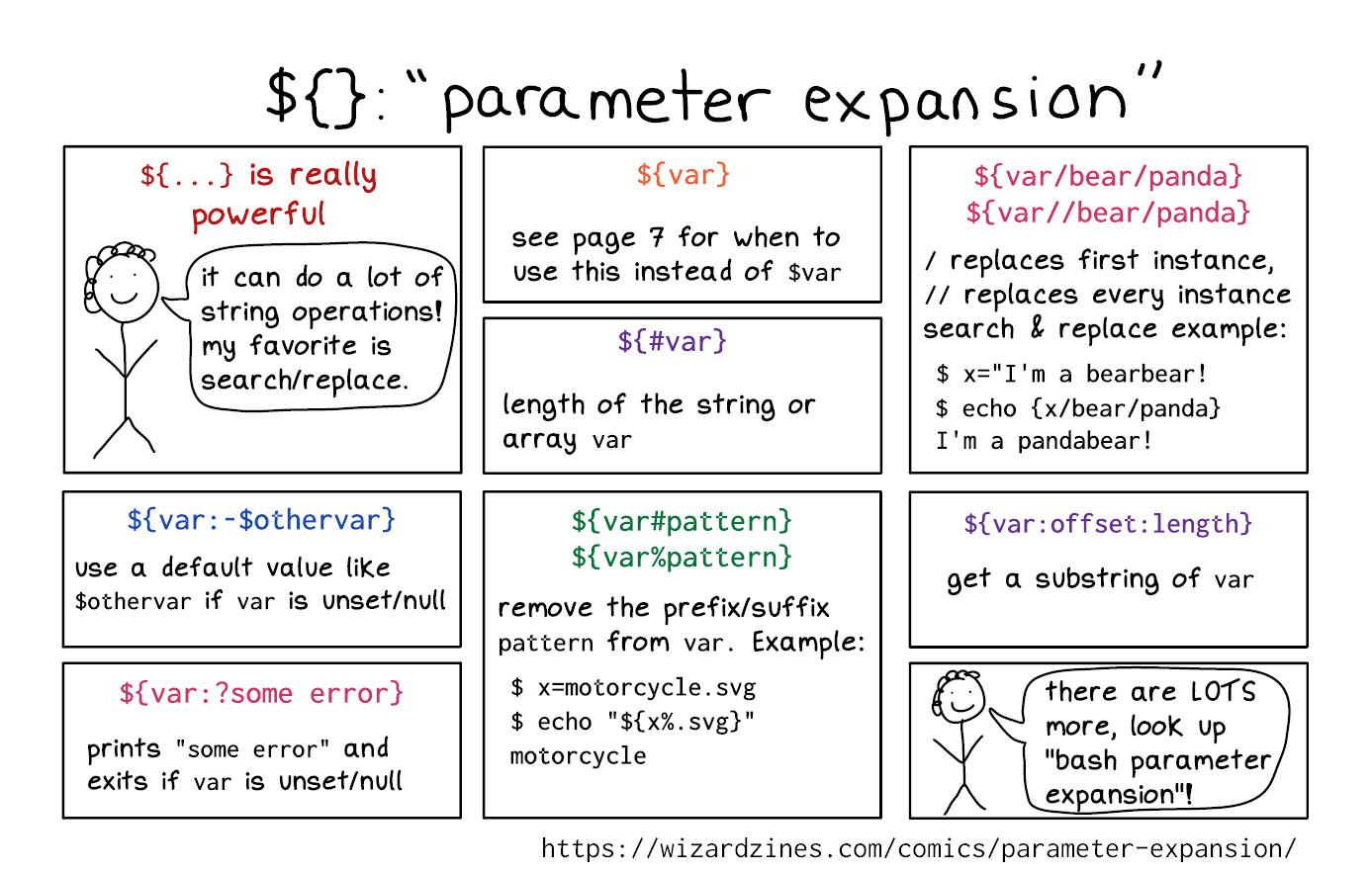
educator! Her excellent comics can be found at <a href="https://wizardzines.com">Wizard Zines</a>.
I signed up for her bite-sized comics a while ago and they’re wonderful!
You can sign up on the wizardzines.com/comics/ link above.
Here’s one I received today:</p>

<p><img src="https://wizardzines.com/comics/parameter-expansion/parameter-expansion.png" alt="Julia Evans's comic explaining bash parameter expansion!" /></p>

<p>I’m constantly looking up how to do bash string manipulation and this comic
summarizes everything so concisely! This is kind of a cheat sheet and
entertaining comic all in one.</p>

<p>If you like these, definitely pick up some of the comics on
wizardzines.com. I have a few of them and found them both entertaining and
useful for my day-to-day work.</p>]]></content><author><name>Parker Moore</name></author></entry><entry><title type="html">Emotional Intelligence - Craig Mod</title><link href="https://stuff.parkermoore.de/2020/09/08/emotional-intelligence-craig-mod.html" rel="alternate" type="text/html" title="Emotional Intelligence - Craig Mod" /><published>2020-09-08T07:44:17-07:00</published><updated>2020-09-08T07:44:17-07:00</updated><id>https://stuff.parkermoore.de/2020/09/08/emotional-intelligence-craig-mod</id><content type="html" xml:base="https://stuff.parkermoore.de/2020/09/08/emotional-intelligence-craig-mod.html"><![CDATA[<p>Craig Mod is a new name to me, but I really appreciate this essay in a
recent edition of <a href="https://craigmod.com/roden/">Roden</a>, one of his
newsletters. It was shared in issue #104 of <a href="https://www.densediscovery.com/archive/">Dense Discovery</a>.</p>

<p>Craig’s analysis of what makes for an emotionally intelligent person
resonates with me:</p>

<blockquote>
  <p>I find high emotional intelligence is defined by a refined sense of
empathy, thoughtfulness, brilliance, kindness, and curiosity. High
emotional intelligence is the antipode to bombastic jingoisms, and
signals an overcoming of childish impulses. Most importantly: High
emotional intelligence does not suffer sloth. Lazy responses are often
physical responses, takedowns, attacks, slanders, ad hominems. Someone
with high emotional intelligence rises above the low-hanging response,
takes time to compose themself, and responds with clarity and with a
clear goal in mind.</p>
</blockquote>

<p>This kind of calm is uncharacteristic of our world’s discourse, each issue
fighting for the world’s attention, delivering an increasingly dark and
panicked message. Clarity comes from turning down this fight-or-flight
instinct, separating the message from the alarm, and taking a careful look
at the issue.</p>

<p>Craig has a dim view of social media’s role:</p>

<blockquote>
  <p>It’s easy to pick on social media, but perhaps more than any tool in
history, social media rewards, amplifies, and encourages a
self-immolation of any emotional intelligence someone may have. The less
emotionally intelligent the tweet, the more likes, the more retweets.</p>
</blockquote>

<p>This seems right to me. The 250-character dunking that folks do on Twitter
isn’t improving anyone’s lives. The rage-inducing headlines that are shared
on Facebook aren’t improving anyone’s understanding of the issues. All
these things do is make us less human and more beast.</p>

<blockquote>
  <p>Personal attacks are often emotionally driven attacks. And in that sense,
they are perhaps the simplest indication of someone with low emotional
intelligence. Personal attacks represent low impulse-control. They are
childish by default, and often have no lasting useful effect. Folks who
tend to attack — rather than deconstruct, or empathize — are often
trapped in tremendously narrow world views. They tend to see all
relationships as existing within a thin column, a tight hierarchy of
being above or below each other. And in service to that “alpha” pole
position at the top of the column, they need to attack and make sure you
or your work sits below.</p>
</blockquote>

<p>Talk about clarity. This particular passage reminds me of <a href="https://www.goodreads.com/book/show/51152447-caste">“Caste: The
Origins of Our Discontents” by Isabel Wilkerson</a>,
which is presently the Oprah Book Club’s pick. This “tremendously narrow
world view” is that of the caste – our social hierarchy made into steel and
concrete. The impulse to maintain this caste system is so strong, it can
only be overcome with emotional intelligence.</p>

<p>Read the whole essay. It’s worth your time.</p>]]></content><author><name>Parker Moore</name></author></entry><entry><title type="html">Online Privacy Should Be Modeled on Real-World Privacy - Daring Fireball</title><link href="https://stuff.parkermoore.de/2020/09/08/online-privacy-should-be-modeled-on-real-world-privacy.html" rel="alternate" type="text/html" title="Online Privacy Should Be Modeled on Real-World Privacy - Daring Fireball" /><published>2020-09-08T07:37:08-07:00</published><updated>2020-09-08T07:37:08-07:00</updated><id>https://stuff.parkermoore.de/2020/09/08/online-privacy-should-be-modeled-on-real-world-privacy</id><content type="html" xml:base="https://stuff.parkermoore.de/2020/09/08/online-privacy-should-be-modeled-on-real-world-privacy.html"><![CDATA[<p>John Gruber, author of Daring Fireball, really rips into the
privacy-destroying tracking companies’ complaints about Apple’s changes in
iOS 14. There’s a bit more vitriol than I care for, but on the whole I
agree with Gruber’s assessment: Apple’s change here highlights the
downright creepy and inappropriate ways apps and websites track us as we go
about our daily lives.</p>

<blockquote>
  <p>Just because there is now a multi-billion dollar industry based on the
abject betrayal of our privacy doesn’t mean the sociopaths who built it
have any right whatsoever to continue getting away with it. They talk in
circles but their argument boils down to entitlement: they think our
privacy is theirs for the taking because they’ve been getting away with
taking it without our knowledge, and it is valuable. No action Apple can
take against the tracking industry is too strong.</p>
</blockquote>

<p>I am eager to get my hands on iOS 14 for this feature alone – stop tracking
me!</p>]]></content><author><name>Parker Moore</name></author></entry><entry><title type="html">Inside a CODE RED: Network Edition - Signal vs Noise</title><link href="https://stuff.parkermoore.de/2020/09/08/inside-a-code-red-network-edition.html" rel="alternate" type="text/html" title="Inside a CODE RED: Network Edition - Signal vs Noise" /><published>2020-09-08T07:29:41-07:00</published><updated>2020-09-08T07:29:41-07:00</updated><id>https://stuff.parkermoore.de/2020/09/08/inside-a-code-red-network-edition</id><content type="html" xml:base="https://stuff.parkermoore.de/2020/09/08/inside-a-code-red-network-edition.html"><![CDATA[<p>This post on the blog of Basecamp (née 37signals) tells a wonderful and
tragic and altogether human story of operating a modern web product. I can
tell you that this kind of introspection is always good, though there’s a
little too much self-blame for my taste – these things happen and it’s best
to learn from them and prevent them from happening again rather than
spending time feeling like you messed up. I especially liked this passage:</p>

<blockquote>
  <p>We also need to raise our sense of urgency for rapid follow up on outage
issues. That doesn’t mean we just add them to our list. We need to clear
room for post-incident action explicitly. I will clarify the priorities
and and explicitly push out other work.</p>
</blockquote>

<p>Follow-up work after an incident is absolutely crucial. It prevents these
same problems from recurring, but more importantly it gives the team the
confidence to continue innovating knowing that there is one less thing to
worry about.</p>

<p>Well done, and thanks for sharing your experience, Basecamp team!</p>]]></content><author><name>Parker Moore</name></author></entry></feed>